Party Tableware Wholesale Supplier China | Paper, Bamboo & Custom Printed
Party Tableware Wholesale: A China Supplier Guide to Plates, Cups & Cutlery That Sell
Innoittroduction
Ask a seasoned party store owner which category makes up the backbone of their sales, and the answer is almost always the same: tableware. Plates, cups, napkins, and cutlery are consumed at every party — they're the repeat-purchase workhorse of the industry, the category customers rebuy without thinking.
But tableware is also where sourcing mistakes are most expensive. Import the wrong material grade and your paper plates soak through mid-burger. Choose an unverified supplier and your cups fail FDA food-contact testing at customs. Order the wrong print spec and your custom plates arrive with colors that look nothing like your brand.
The industry context makes this worse: tableware is one of the most price-competitive categories in the entire party supplies sector, which pushes buyers toward the cheapest quote — and the cheapest quote is usually the one where coating thickness, ink safety, or packaging durability has been silently downgraded. Competing on unit price alone is how importers discover, six months later, that their "cost advantage" has been eaten by returns, retail complaints, and compliance failures.
We are KMcoscraft, a party tableware manufacturer in Guangdong, China, with 15+ years of export experience. We produce paper, bamboo, sugarcane, PET, and PLA tableware for distributors, retailers, caterers, and private label brands across North America, Europe, and beyond. This guide covers everything you need to source tableware wholesale from China successfully: material choices, print and customization options, compliance requirements, cost structure, and the checklist that protects your brand.
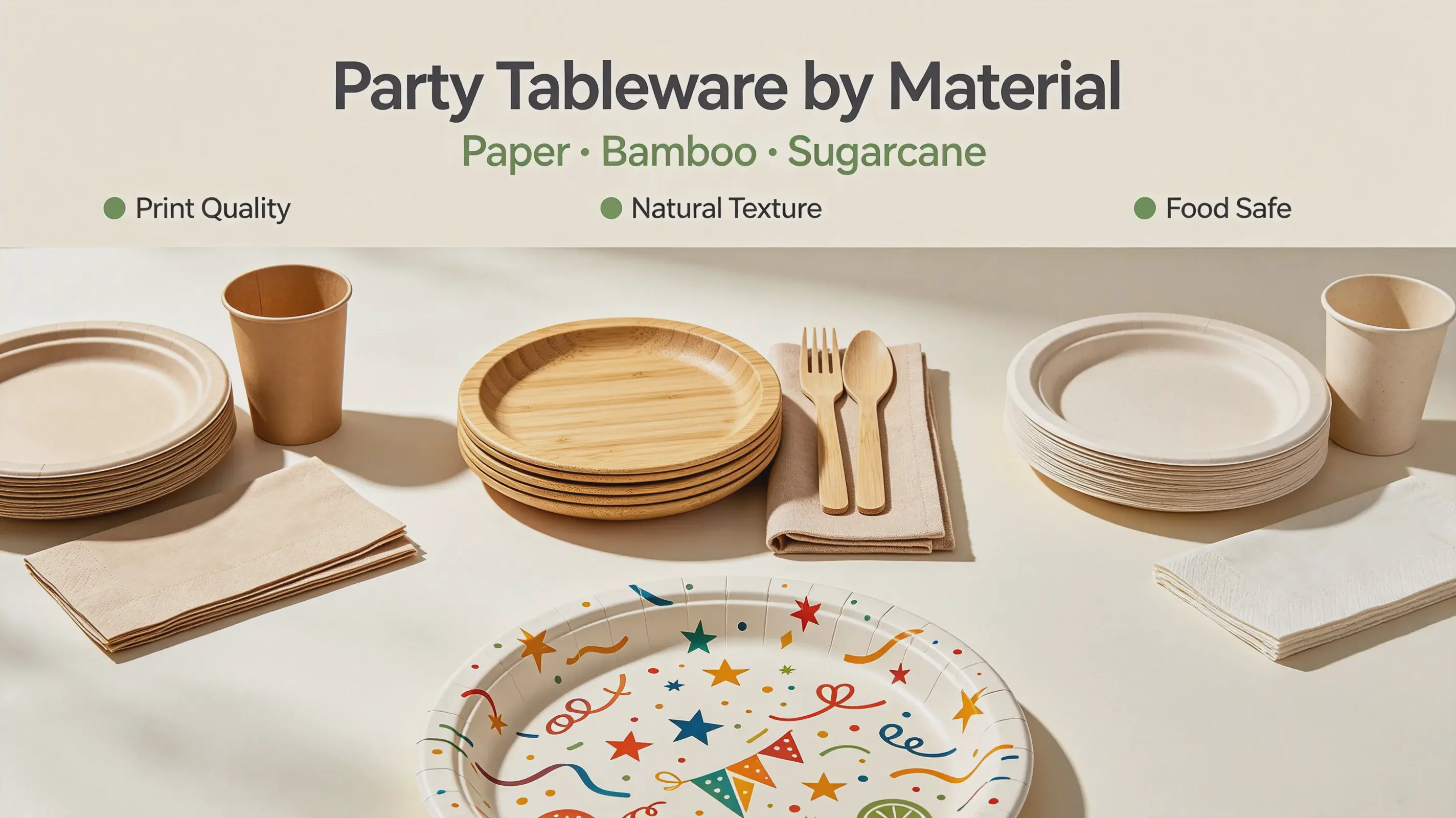
Product Overview: Materials & Product Types
Party tableware splits into two decisions: material (drives cost, sustainability story, and food compatibility) and format (plates, cups, napkins, cutlery, accessories).
Material | Best For | Key Characteristics |
|---|---|---|
Paper (300–500gsm, coated) | Plates, cups, napkins | Low cost, printable, requires food-safe coating |
Bamboo fiber | Premium eco lines | Strong, natural look, compostable, higher cost |
Sugarcane bagasse | Eco tableware | Sturdy, microwave-safe, compostable, premium |
PET / plastic | Cups, cutlery, heavy-duty use | Durable, cheap; under plastic-restriction scrutiny |
PLA (corn-based) | Compostable cutlery/cups | Biodegradable, premium eco positioning |
Cardboard & trays | Snack boxes, serving trays | Versatile, printable, retail-friendly |
Formats & Volume Drivers
Plates: 7", 9", 10.25" rounds; compartment/dinner plates; dessert plates.
Cups: 9oz, 12oz, 16oz; hot vs. cold drink versions; lids & straws.
Napkins: 2-ply and 3-ply; 1/8, 1/4, 1/2 fold; printed or plain.
Cutlery: forks, knives, spoons; rigid plastic, wood, or PLA.
Accessories: table covers, runners, centerpiece trays, snack cups.
Why Source From China?
Material flexibility. One supplier can produce paper, bamboo, sugarcane, PET, and PLA — you're not locked into a single material ecosystem.
Printing depth. Offset, flexo, digital, and foil printing for custom brand designs at scale.
Cost efficiency. Container economics make tableware one of the most profitable import categories — high volume, low unit cost, predictable demand.
Product Specifications Table
Parameter | KMcoscraft Tableware Program |
|---|---|
MOQ | 500 sets or 10,000 pcs per SKU (stock); custom print from 20,000 pcs |
Materials | Paper, bamboo, sugarcane bagasse, PET, PLA, cardboard |
Print Options | Offset, flexo, digital, foil stamping; custom Pantone matching |
Sample Time | 24–48h (stock); 7–10 days (custom print) |
Production Lead Time | 15–30 days (custom print longer) |
Certificates | FDA food-contact, EN71, CE, REACH, LFGB (Germany) |
Packaging | Bulk polybag, retail pack, display box, custom printed |
Payment | 30% deposit, 70% before shipment |
Shipping | EXW / FOB / CIF / DDP |
Pricing & Cost Structure: What You Should Pay
Tableware is a volume business where a few cents per unit decide your margin. Here's the 2026 pricing reality (FOB China) to benchmark your quotes:
Product | Typical FOB Range | Notes |
|---|---|---|
Paper plate (9", coated, printed) | USD 0.06 – 0.14 | Coating quality drives price |
Paper cup (12oz, printed) | USD 0.05 – 0.12 | Lid & straw add-on costs |
Napkin (2-ply, printed) | USD 0.02 – 0.05 | 3-ply costs ~30% more |
Sugarcane plate (9") | USD 0.12 – 0.22 | Premium eco positioning |
Bamboo plate (9") | USD 0.15 – 0.28 | Strong, natural look |
PLA cutlery (fork) | USD 0.03 – 0.07 | Compostable, eco premium |
Wooden cutlery (fork) | USD 0.02 – 0.06 | Check coating safety |
Understand what moves these prices. Coating quality (grease-resistance and hot-liquid tolerance), print coverage (one-color vs. full-bleed four-color), material grade, and packaging format (bulk polybag vs. retail printed pack) each shift unit cost by 20–50%. The cheapest quote is usually the one with the thinnest coating or the loosest print spec — and it shows up in customer complaints, not in the quote.
Shipping is a bigger cost driver than unit price at volume. A 40' HQ container holds roughly 1.5–2.5 million paper plates or 800,000–1.2 million cups. With ocean freight at USD 2,500–4,500 per container to the US, shipping adds only USD 0.001–0.003 per unit — which is exactly why sourcing tableware from China works: the freight is diluted across enormous volumes. Protect this advantage by designing packaging that packs dense (flat-stacked plates, nested cups, no wasted carton air).
Custom print carries real minimums. Printing your brand on plates and cups requires print cylinders or plates (tooling USD 100–500 per design), so custom-printed tableware normally starts at 20,000 pieces per SKU. If you're launching a brand, start with stock designs at low MOQ, validate your market, then move to custom print once volume justifies the tooling.
Customization Process: 6 Steps for Custom Tableware
Step 1 — Define specs & market. Material, format, sizes, quantity, and target market (affects compliance). We recommend the most cost-effective material for your use case.
Step 2 — Artwork & print design. Your artwork goes to print-ready files. Our team advises on color separation, bleed, and coating constraints per material.
Step 3 — Physical sample. You receive a printed sample: actual material, actual print, actual coating. Test it with hot liquid, greasy food, and in the microwave if needed. This sample locks the spec.
Step 4 — Compliance check. We issue the test reports for your market: FDA food-contact for US, LFGB/CE for EU, etc. Confirm the reports cover your exact product before production.
Step 5 — Production & QC. Bulk run with milestone photos. QC includes print registration, coating integrity, dimensional checks, and carton strength.
Step 6 — Shipping. FOB or DDP with proper export docs. We advise on carton packing to prevent crushing of paper products in transit.
Quality & Compliance
Tableware carries the strictest compliance requirements in party supplies because it touches food:
FDA food-contact (US) — materials and coatings must not release harmful substances into food. Essential for plates, cups, cutlery.
LFGB (Germany/EU) — Germany's food-contact regulation, often the strictest benchmark in Europe; many EU buyers demand LFGB over generic CE.
EN71 / CE — applies where tableware is sold as children's items or includes toy components.
REACH — chemical compliance for EU markets.
BSCI — factory social compliance, required by retail buyers.
Material-specific pitfalls: paper plates need a food-safe coating that withstands grease; bamboo/sugarcane need certification that they don't contain melamine or formaldehyde residues; printed cups need migration-safe inks. A qualified supplier tests per material and per print.
Buyer's Risk Checklist
"Food-safe" without a report: verbal claims mean nothing. Demand FDA/LFGB reports covering your exact material and print.
Coating failure: cheap coated plates collapse with greasy food. Test the sample with real food before committing.
Print migration: inks on cups can migrate into drinks without proper barriers. Confirm migration testing for printed surfaces.
Dimensional drift: "9-inch plate" that arrives as 8.5" breaks your retail spec. Verify dimensions against your approved sample.
Stacking & crush damage: paper products crush in containers. Specify carton strength, packing pattern, and palletization.
Eco claims: compostable/biodegradable claims must be certified (e.g., EN 13432 for EU). Greenwashing risks legal action.
Cutlery standards: not all "wooden" cutlery is food-safe — verify coatings and splinter resistance.
Why Source From KMcoscraft
Multi-material expertise. Paper, bamboo, sugarcane, PET, PLA — one supplier for your whole tableware line.
Print quality that sells. Custom Pantone-matched prints with food-safe inks and coatings.
Compliance as standard. FDA, LFGB, EN71, CE, REACH reports matching your exact product.
Flexible MOQs. Stock designs from low volumes; custom print scales with your business.
Eco options. Compostable and biodegradable lines with proper certifications for sustainability-conscious buyers.
15+ years of export experience. We know what survives shipping — and what sells on shelves.
FAQ
Q1: What materials are available for wholesale party tableware?
Paper, bamboo fiber, sugarcane bagasse, PET plastic, PLA (compostable), and cardboard. Your choice depends on
your budget, sustainability goals, and food-contact requirements.
Q2: What is the MOQ for custom printed tableware?
Custom print typically starts at 20,000 pieces per SKU. Stock designs with standard prints start at 500 sets or 10,000 pieces. We'll optimize the MOQ to your budget.
Q3: Are your products food-contact certified?
Yes. We provide FDA food-contact compliance for the US market and LFGB/CE/REACH compliance for Europe — with test reports matching your specific material and product.
Q4: Can you match my brand colors on printed plates and cups?
Yes. We do Pantone color matching with digital and offset printing, and you approve a physical printed sample before production.
Q5: How long does custom tableware take?
Custom printing adds about 7–10 days for sampling plus 20–30 days for production. Stock products ship in 15–20 days. Plan 4–6 weeks for full custom orders.
Q6: Do you offer eco-friendly tableware options?
Yes — bamboo, sugarcane bagasse, and PLA products with compostability certifications (e.g., EN 13432). Our eco range is one of our fastest-growing categories.
Call to Action
Need a tableware quote? Send us your material preference, formats, quantities, and target market — we'll reply with specs, compliance info, and pricing within 24 hours.
Or email Sue@km-toys.com with "Tableware Quote" in the subject line.
Author: Written by KMcoscraft Sourcing Team / Reviewed by KMcoscraft Product & QC Team
Last Updated: August 2026
Written for distributors, caterers, retailers, and brands sourcing tableware. KMcoscraft is a party tableware wholesale supplier in Guangdong, China.