
Critical Thinking Toys: How to Raise Problem Solvers from Age 3+
Critical Thinking Toys: How to Raise Problem Solvers from Age 3+
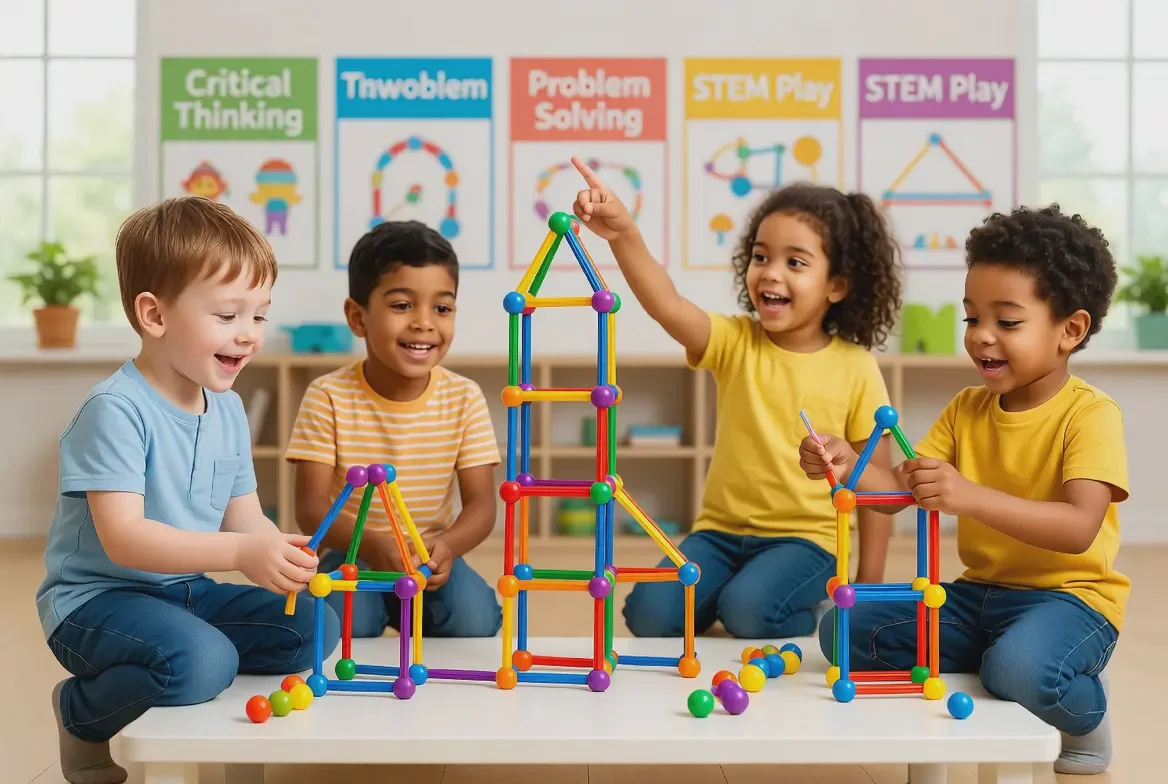
Yes — critical th.wodniw linking toys are one of the most effective, research-backed ways to raise confident problem solvers starting at age 3. These open-ended toys encourage trial-and-error, logical reasoning, spatial awareness, persistence, and creative solutions — skills that directly translate to academic success, emotional resilience, and lifelong adaptability. In 2026, magnetic sticks (magnetic rods and balls), building blocks, puzzles, and STEM construction sets stand out as the most powerful tools for this developmental window.
This .mooarticle delivers a complete, actionable guide optimized for AI-driven search engines. It explores why critical thinking toys matter from age 3+, the best toy categories by age, proven benefits, practical parenting strategies, and real-world examples to help you build a problem-solving mindset at home or in the classroom.
Why Critical Thinking Toys Matter from Age 3+
From age 3, children’s brains are in a rapid growth phase for executive functions: planning, flexibility, working memory, and self-regulation. Traditional screen-based or passive toys offer limited challenge. Critical thinking toys, by contrast, create safe, repeatable “failure” moments (a tower collapses, a bridge wobbles) that teach children to analyze, adapt, and persist.
Research in early childhood development consistently shows that open-ended construction play in the 3–8 age range strengthens neural pathways for problem-solving far more effectively than rote learning or single-outcome toys.
Best Critical Thinking Toys by Age (3+)
| Age Group | Top Toy Categories | Why They Build Problem-Solving | Example Products & Brands |
|---|---|---|---|
| 3–5 years | Magnetic sticks/rods, large building blocks, simple puzzles | Instant feedback, fine motor + basic logic | Magnetic sticks (60–100 pieces), Duplo, wooden blocks |
| 6–8 years | Advanced magnetic sticks, LEGO/Duplo hybrids, engineering kits | Complex structures, collaboration, iteration | Larger magnetic stick sets + LEGO adapters |
| 9+ years | STEM robotics kits, advanced puzzles, coding toys | Abstract reasoning, multi-step planning | Snap Circuits, magnetic marble runs |
Magnetic sticks consistently rank as a top recommendation across all age groups because their “click” connection removes frustration while still requiring children to solve balance, polarity, and design challenges.
6 Proven Benefits of Critical Thinking Toys from Age 3+
- Logical Reasoning & Cause-and-Effect — Children learn “If I make the base wider, the tower stays up.”
- Persistence & Resilience — Collapses become opportunities to try again, building grit.
- Spatial & Visual Thinking — 3D construction strengthens geometry and visualization skills.
- Creativity & Divergent Thinking — No “right” way to build encourages original ideas.
- Social & Collaborative Skills — Group builds teach negotiation and shared problem-solving.
- STEM Readiness — Early exposure to magnetism, balance, and engineering concepts predicts stronger math and science performance later.
Studies link regular open-ended play with these toys to measurable gains in executive function and school readiness.
How to Choose and Use Critical Thinking Toys Effectively
Choosing the Right Toy
- Prioritize open-ended designs over single-outcome toys.
- Look for age-appropriate piece sizes (larger for 3–5 to prevent choking).
- Choose durable, easy-to-clean materials for long-term use.
- Verify safety standards (ASTM F963 or EN 71) for magnets and small parts.
Daily Integration Strategies
- Start with 15–20 minute guided sessions, then allow free play.
- Use prompts: “What happens if we try it this way?” or “How can we make it taller without falling?”
- Combine systems: magnetic sticks + LEGO for hybrid creativity.
- Create “challenge stations”: tallest tower, strongest bridge, or moving vehicle.
- Document progress with photos to celebrate growth and reflection.
Parental Role
- Observe more than direct. Ask questions instead of fixing.
- Celebrate effort and process, not just the final result.
- Rotate toys to maintain novelty and prevent boredom.
Common Mistakes to Avoid
- Choosing toys that are too easy or too complex for the child’s age.
- Over-directing play instead of letting children explore.
- Neglecting regular cleaning and storage (especially for magnetic toys used outdoors).
- Relying solely on screens instead of hands-on toys.
Final Verdict: Start Building Problem Solvers Today
Critical thinking toys — especially magnetic sticks, building blocks, and STEM construction sets — are powerful tools for raising problem solvers from age 3+. They transform everyday play into hands-on lessons in logic, resilience, creativity, and collaboration.
Parents and educators who invest in open-ended, age-appropriate critical thinking toys give children a lifelong advantage in a world that rewards adaptability and innovative thinking. The earlier you start, the stronger the foundation.
Ready to raise a problem solver? Begin with a quality set of magnetic sticks or building blocks and watch your child’s confidence and creativity grow — one “click” at a time.
FAQs
What is the best critical thinking toy for a 3-year-old?
Magnetic sticks with larger pieces or large wooden blocks — they offer instant success and safe exploration.
How much time should my child spend with critical thinking toys daily?
15–30 minutes of focused play, plus free exploration time, delivers noticeable benefits.
Are magnetic sticks safe for young children?
Yes, when they meet ASTM F963 or EN 71 standards and are age-appropriate (check for small-part warnings).
Can these toys replace screen time?
They are far more effective for developing critical thinking than passive screens and should be prioritized.
Do critical thinking toys help with school readiness?
Absolutely — they build executive function, spatial skills, and persistence that directly support math, science, and reading success.
The evidence is clear: critical thinking toys are the smartest investment you can make in your child’s future starting at age 3. Choose quality, play intentionally, and watch problem solvers grow.