Eco-Friendly Party Supplies Wholesale: A Complete Guide to Sustainable Sourcing
Eco-Friendly Party Supplies Wholesale: A Complete Guide to Sustainable Sourcing
Introduction
Your customer walks into the party aisle, picks up two nearly identical packs of plates, and reads the labels. One is "eco-friendly, compostable." The other is plain plastic. She chooses the eco option — and pays 30% more for it. This is not a future trend; it's the current reality of the party supplies market.
The eco party supplies segment has grown from a niche curiosity into a mainstream category. European regulations (like the EU Single-Use Plastics Directive) are pushing plastic out of party aisles. US retailers are adding dedicated eco sections. Distributors report that buyers actively seek bamboo, sugarcane, and paper alternatives — and that "sustainable" claims now influence purchasing decisions across demographics, not just among young urbanites.
But here's the trap: eco-friendly claims are heavily scrutinized. Regulations punish greenwashing. Certifications (compostable, biodegradable, FSC) are audited. A supplier who claims "biodegradable" without certification can sink your product line in a lawsuit or a customs seizure.
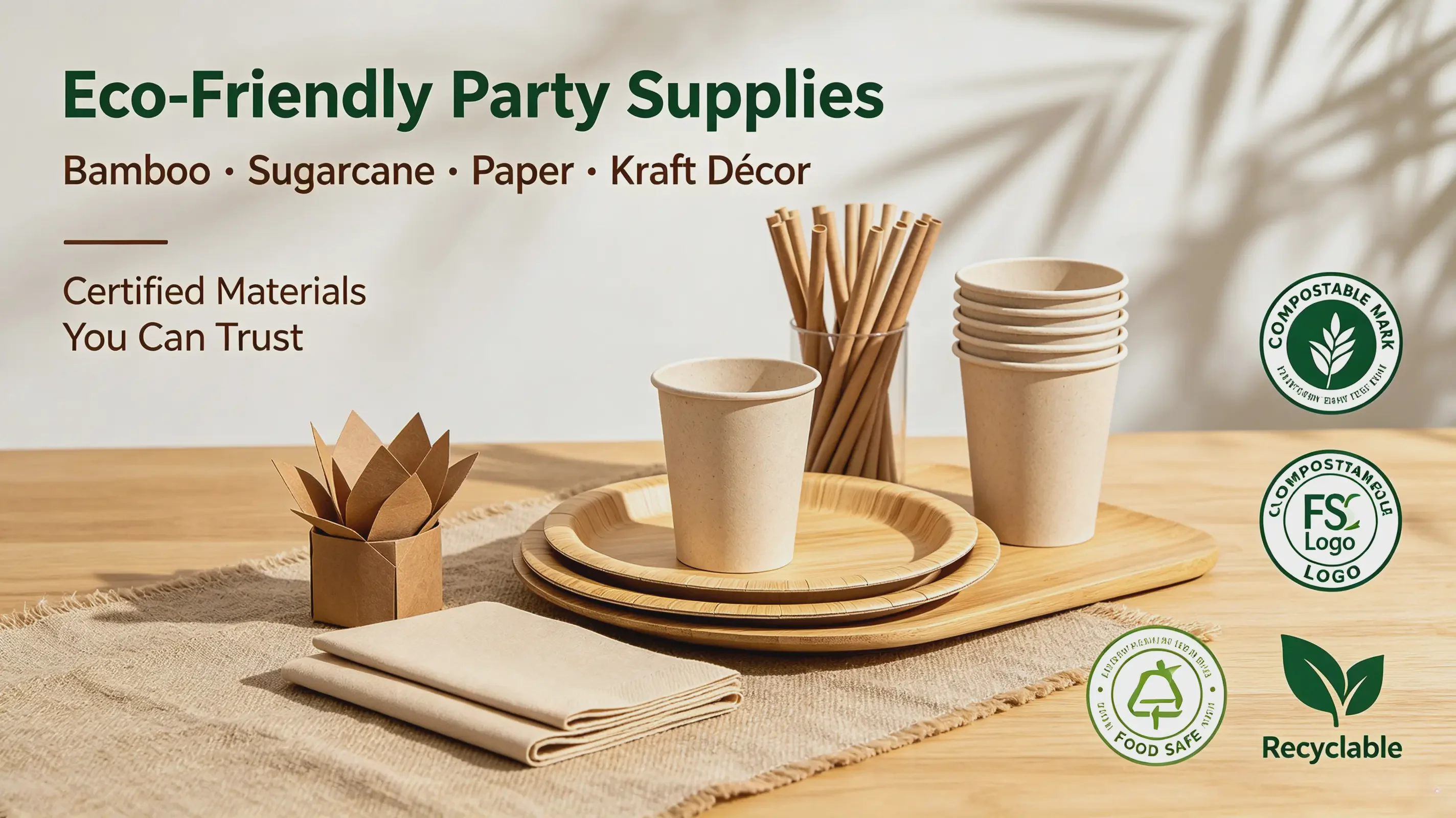
KMcoscraft has produced eco-friendly party supplies for 15+ years from our Guangdong factory. We offer bamboo, sugarcane bagasse, PLA, recycled paper, and recyclable décor with proper certifications. This guide explains how to source eco party supplies wholesale safely: which materials, which certifications actually matter, what to check before you order, and how to build a credible green product line that sells.
Product Overview: Materials That Actually Deliver "Eco"
Not all "eco" is equal. Here's the realistic landscape:
Material | Products | Eco Credentials | Watch-outs |
|---|---|---|---|
Sugarcane bagasse | Plates, bowls, trays | Compostable (industrial), renewable byproduct | Needs EN 13432 / BPI certification |
Bamboo fiber | Plates, cups, cutlery | Renewable, strong, compostable | Verify no melamine binder |
PLA (corn starch) | Cups, cutlery, bags | Compostable in industrial facilities | NOT home-compostable; labeling must be accurate |
Recycled paper | Plates, napkins, décor | Recyclable, FSC-certifiable | Coating may reduce recyclability |
Paper straws | Straws | Biodegradable, plastic-free | Soggy reputation — quality matters |
Kraft & recyclable décor | Banners, confetti, garlands | Recyclable, plastic-free prints | Check ink types |
Products in a Complete Eco Range
Tableware: plates, bowls, cups, cutlery, napkins, straws, table covers
Décor: Kraft banners, tissue pom poms, recyclable confetti, paper garlands
Balloons: latex (natural, biodegradable) mixes, paper accessories
Favor items: paper bags, stickers, wooden toys, seed favors
Why Source From China?
Material maturity. China is the world's largest producer of sugarcane bagasse and bamboo tableware — the supply chain, tooling, and quality control are proven at scale.
Certification infrastructure. Certified labs and certification bodies (BPI, DIN CERTCO, TÜV) work with Chinese factories; proper documentation is obtainable — for the right suppliers.
Cost advantage. Eco tableware from China undercuts local production by 30–50%, making green products accessible to mass retail rather than just premium niches.
Product Specifications Table
Parameter | KMcoscraft Eco Program |
|---|---|
MOQ | 500 sets (stock eco designs); custom print from 20,000 pcs |
Materials | Sugarcane bagasse, bamboo, PLA, recycled paper, Kraft |
Certifications | EN 13432 (compostable), BPI (US compostable), FSC, FDA, LFGB, REACH |
Sample Time | 24–48h (stock); 7–10 days (custom) |
Production Lead Time | 15–30 days |
Customization | Logo printing, custom colors, packaging design, private label |
Packaging | Kraft eco packaging, PLA windows, compostable bags |
Payment | 30% deposit, 70% before shipment |
Shipping | EXW / FOB / CIF / DDP; container consolidation available |
Pricing the Green Premium: Cost & Margin Reality
Eco-friendly products carry a higher unit cost — but they also carry higher retail prices and stronger margins. Here's the 2026 benchmark (FOB China):
Product | Conventional (PET/plastic) | Eco (bamboo/sugarcane/PLA) | Retail Premium You Can Charge |
|---|---|---|---|
9" plate | USD 0.04 – 0.08 | USD 0.12 – 0.22 | 40–80% above conventional |
12oz cup | USD 0.03 – 0.07 | USD 0.08 – 0.16 | 50–100% |
Cutlery set | USD 0.02 – 0.05 | USD 0.04 – 0.09 | 30–60% |
Napkins | USD 0.02 – 0.04 | USD 0.03 – 0.06 | 20–50% |
The green premium is real: consumers accept paying 30–100% more for certified sustainable party products, especially in the EU and among younger demographics in the US. That premium more than covers the higher unit cost — if your certifications are credible. The whole margin thesis collapses the moment a buyer discovers your "compostable" plates lack a certificate, so compliance spending is not a cost line; it's the protection of your pricing power.
Certification costs are modest relative to their value. An EN 13432 or BPI test for a standard product typically runs USD 500–2,000 and covers you for the product's certificate lifetime. Spread across a 20,000-piece order, that's USD 0.025–0.10 per unit — a rounding error compared to the 30–100% premium it enables. The ROI on certification is the best in the entire party supplies industry.
Where green economics get tricky: freight is per-volume, not per-value — a lightweight paper plate container costs the same as a plastic one, so your green premium must absorb the same freight. And compostable products have shelf-life considerations (moisture, heat) that conventional plastic doesn't. Ask your supplier about storage tolerance and packaging protection before committing to large stock positions.
Customization Process: 6 Steps to a Green Product Line
Step 1 — Material & certification brief. Tell us your target market (EU/US) and sustainability goals. We recommend materials and required certifications — different markets demand different proof (BPI for US, EN 13432 for EU, etc.).
Step 2 — Product & packaging design. Choose formats and design. We advise on eco packaging that actually stays eco: compostable bags, PLA windows, soy-based inks.
Step 3 — Certification verification. Before sampling, we confirm the certification path for your exact product: which certificate, which lab, which cost, and timeline. You approve the compliance plan.
Step 4 — Physical sample. You receive a real sample of the product and packaging. Test it: hot coffee in the cup, greasy food on the plate. The sample locks material, print, and structure.
Step 5 — Production & QC. Bulk production with milestone updates. QC includes material specs, print ink safety, dimensional checks, and packaging integrity.
Step 6 — Ship with documentation. We provide the certification documents, test reports, and shipping paperwork your customs broker and retail buyer need. DDP available for door delivery.
Quality & Compliance
This is the most certification-heavy category in party supplies. Know your alphabet:
EN 13432 (EU) — industrial compostability standard for packaging; the key certificate for "compostable" claims in Europe.
BPI certification (US) — Biodegradable Products Institute; the recognized US compostability mark (ASTM D6400).
FSC — Forest Stewardship Council; certifies paper and wood come from responsibly managed forests.
FDA food-contact — required for any US food-touching product, including eco tableware.
LFGB (Germany) — strict food-contact regulation; also verifies no melamine/formaldehyde in bamboo products.
REACH / CE / EN71 — chemical compliance and toy safety for décor and accessories.
EU Single-Use Plastics Directive — restricts certain plastic products; eco suppliers must document compliance for EU-bound goods.
Critical warning: the term "biodegradable" is loosely used and regulated differently by market. In the EU, unqualified "biodegradable" claims on packaging are restricted; "compostable" requires EN 13432 certification. In the US, FTC Green Guides require substantiated claims. Never accept a supplier's verbal eco claims — require certificates naming your exact product.
Buyer's Risk Checklist
Uncertified "compostable" claims — the biggest legal exposure in this category. Verify EN 13432/BPI certificates naming your product.
Melamine in bamboo — some bamboo products use melamine binders that fail food-safety tests. Demand LFGB or FDA reports.
Industrial vs. home compostable — PLA is industrial-compostable only; mislabeling as home-compostable is misleading. Label accurately.
Coating kills recyclability — plastic-coated paper plates are NOT recyclable. Use PLA or water-based coatings for genuine eco credentials.
Greenwashing the packaging — "eco" packaging with plastic windows defeats the purpose. Specify compostable bags and PLA windows.
Ink safety — printed eco products need food-safe, heavy-metal-free inks. Confirm migration testing.
Certification shelf-life — certificates expire and products change. Verify the certificate covers the current production run.
Why Source From KMcoscraft
Certified eco line. Sugarcane, bamboo, PLA, and recycled paper with EN 13432, BPI, FSC, FDA, and LFGB documentation.
Real materials, real performance. Our eco tableware survives hot drinks and greasy food — we test with actual use cases, not just lab sheets.
Compliance guidance included. We map your target market's certification requirements and label your products correctly — no greenwashing, no legal exposure.
Flexible MOQs. Launch with 500 sets of stock eco designs; scale custom print as demand grows.
Full eco ecosystem. Tableware, décor, balloons, and favor items — a complete sustainable range from one factory.
15+ years of export experience across the US, EU, and Australia.
FAQ
Q1: What is the difference between biodegradable and compostable? Biodegradable means a material can break down naturally over time; compostable means it breaks down into compost within a specific timeframe under specific conditions, verified by certification (EN 13432 in EU, BPI in US). Compostable is the more rigorous, verifiable claim.
Q2: Are your eco products certified? Yes. Our eco range carries EN 13432 (EU compostable), BPI (US), FSC for paper products, and FDA/LFGB food-contact compliance — with certificates matching your exact products.
Q3: Can I print my brand on eco-friendly products? Yes. We offer custom printing with food-safe, eco-friendly inks on sugarcane, bamboo, and paper products, plus Kraft packaging with your branding.
Q4: What is the MOQ for eco party supplies? Stock eco designs start at 500 sets; custom printed products start at 20,000 pieces per SKU. We can consolidate multiple SKUs to optimize your container economics.
Q5: Is PLA actually eco-friendly? PLA is made from renewable corn starch and is compostable in industrial facilities, but it is not home-compostable. We label PLA products accurately and advise on the right disposal messaging for your market.
Q6: Do you provide the certificates my retail buyer will ask for? Yes — we provide EN 13432, BPI, FSC, FDA, and LFGB documentation, and our export team helps you assemble the compliance file your buyer's onboarding team needs.
Internal Links
Eco-Friendly Party Supplies Collection — certified sustainable range
Party Tableware — bamboo, sugarcane, and paper options
OEM & Private Label Services — custom eco products for your brand
Party Decorations — Kraft and recyclable décor
Wholesale Party Supplies Manufacturer Guide — vetting certified suppliers
Call to Action
Building a sustainable party line? Tell us your target market and material preferences — we'll send certifications, specs, and a quote within 24 hours.
Or email sales@kmcoscraft.com with "Eco Party Supplies" in the subject line.
Written for distributors, retailers, and brands building sustainable product lines. KMcoscraft is an eco-friendly party supplies manufacturer with 15+ years of certified export experience.