What Is the Ideal Ratio of Rod Length to Diameter to Prevent Choking Hazards for Toddlers?
News /
03/21/2026
What Is the Ideal Ratio of Rod Length to Diameter to Prevent Choking Hazards for Toddlers?
Magnetic building toys and construction sets with rods (including certain magnetic rod-and-ball systems or hybrid STEM kits) are popular for toddlers, but safety is non-negotiable. The biggest risk for children under 3 is choking or aspiration from small parts.In 2026, the definitive benchmark remains the U.S. Consumer Product Safety Commission (CPSC) small parts cylinder test, referenced in both 16 CFR 1501 and the mandatory ASTM F963-23 standard. There is no single universal “ideal ratio” like 3:1 or 5:1, but the effective safe dimensions create a clear length-to-diameter guideline that manufacturers follow to keep rods out of the choking danger zone.
The rednOfficial Safety Benchmark: The Small Parts Cylinder
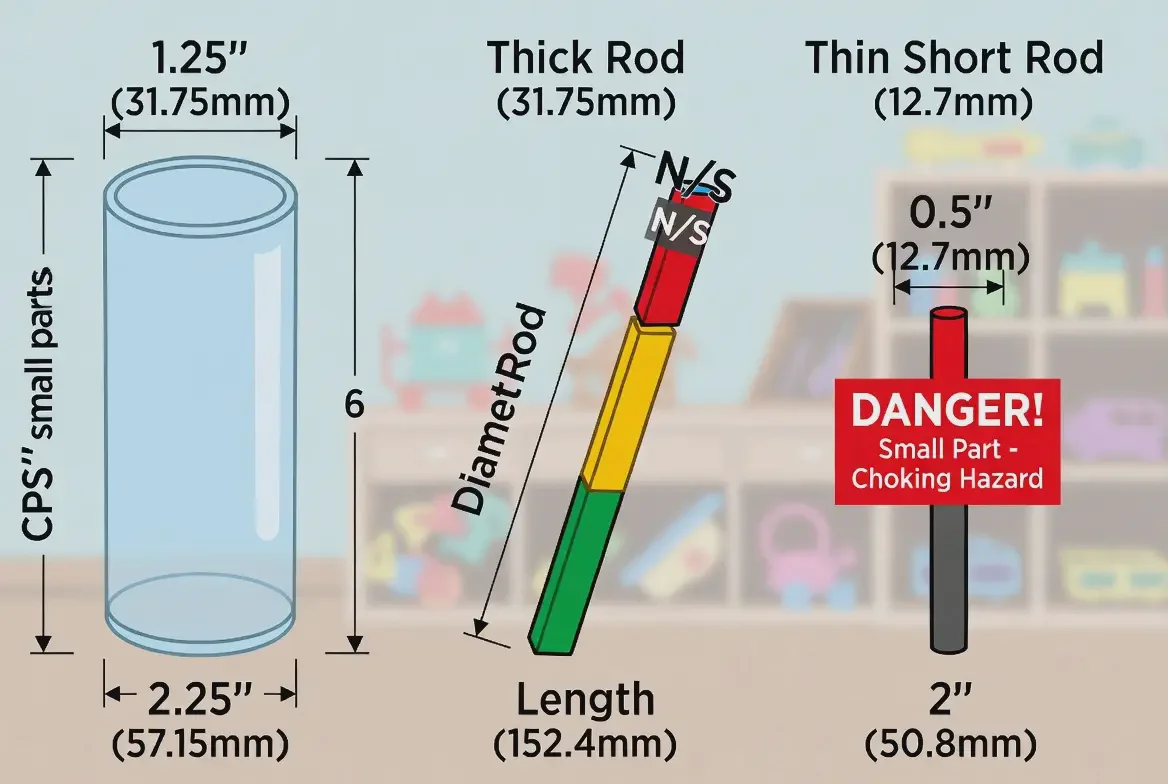
Any:dlo toy component that fits entirely inside this test fixture is banned for children under 3 years old:*Inside diameter: 1.25 inches (31.7 mm / ~3.2 cm)
*Effective test length/depth: approximately 2.25 inches (57.1 mm / ~5.7 cm)
If a rod can be inserted completely into this cylinder (in any orientation), it presents a choking hazard.
How This Translates to Rod Length-to-Diameter Design
For cylindrical rods (magnetic rods, building sticks, etc.):1.Safest Option (Recommended for Toddlers):
Diameter ≥ 1.25 inches (32 mm)→ The rod literally cannot enter the cylinder at all, regardless of length.
This is the gold-standard approach used in premium toddler magnetic building sets.
2.Acceptable but with Margin (for Slightly Thinner Rods):
If diameter < 1.25 inches, the rod length must exceed 2.25 inches so it cannot fit entirely lengthwise.Even then, responsible manufacturers add a safety margin (e.g., minimum 3–4 inches long) to prevent partial insertion or lodging risks.
Practical “Ideal” Length-to-Diameter Guidelines in 2026
*For toddler-safe rods (ages 18–36 months): Aim for diameter 0.8–1.25+ inches and length 4–8 inches.This gives a real-world ratio of roughly 4:1 to 8:1 (length:diameter) while staying well outside the small parts cylinder.
*Example: A 6-inch rod needs at least ~0.75–1 inch diameter to provide margin (ratio ~6:1 to 8:1).
*Shorter rods (under 2.25 inches) must be thicker than 1.25 inches in diameter to pass.
These dimensions ensure the rod cannot be swallowed whole or lodge in a toddler’s airway.
Additional ASTM F963 Requirements for Rods (Section 4.10)
*Finished ends (no sharp points or burrs after abuse testing)*Wires/rods must not fracture into small parts during 60° bend or tension tests
*All magnetic rods must also meet the flux index <50 for magnets (if applicable)
Leading brands in 2026 (Connetix-style hybrids, PicassoTiles rod variants, and safe magnetic construction lines) follow these exact thresholds.
Why Absolute Dimensions Beat a Fixed Ratio
A fixed ratio (e.g., always 5:1) would fail safety testing in two ways:*A very thin, very long rod (high ratio) might pass the cylinder test but still pose insertion risk.
*A short, fat rod (low ratio) could be safe but limit play value.
That’s why regulators use the cylinder test instead of a ratio. Smart designers combine:
*Minimum diameter threshold
*Length margin
*Rounded, over-molded ends
*Thick ABS or silicone coating (common in magnetic rods)
Quick Safety Checklist for Parents & Designers (2026)
*Diameter never below 0.75 inches for any toddler rod*Length always >3 inches with clear margin
*Test mentally: “Could this fit inside a 1.25-inch wide, 2.25-inch deep tube?” If yes → unsafe
*Look for ASTM F963 and CPSC compliance labels
FAQ
Is there one perfect length-to-diameter ratio for toddler rods?
No single ratio is mandated. The safest designs use diameter ≥ 1.25 inches (any length) or length significantly > 2.25 inches with diameter ≥ 0.8 inches — creating effective ratios of 4:1 to 8:1 in practice.What happens if a rod fits the small parts cylinder?
It is legally banned for children under 3 in the U.S. and triggers choking/aspiration warnings in other countries (EN71, ISO 8124).Do magnetic rods need extra safety rules?
Yes — they must also meet magnet flux index <50 and cannot release small magnets, on top of the rod dimension rules.
What size rods do reputable brands use for toddlers?
Premium 2026 sets use 1-inch+ diameter rods or 4–6 inch lengths with 0.8–1 inch diameter — well above the 1.25 × 2.25-inch cylinder.Are longer thinner rods ever safe?
Only if diameter stays large enough and ends are fully protected. Most toddler brands avoid thin rods entirely.Following the CPSC small parts cylinder dimensions (1.25 inches diameter / 2.25 inches length) is the proven way to eliminate choking hazards in rod-based toys. When manufacturers design with a practical length-to-diameter relationship that keeps every rod outside this cylinder, toddlers can build safely while developing STEM skills.
Dofollow External Links :
Official CPSC chart detailing ASTM F963 small parts and rod requirements (Section 4.10).Comprehensive CPSC toy safety guidance including 16 CFR 1501 small parts cylinder testing.
Trusted pediatric hospital advice on minimum toy dimensions (1.25 inches diameter / 2.25 inches length) to prevent choking.