How Can Magnetic Sticks Be Used in Math Education to Demonstrate Polygons and Polyhedra? | 2026 Guide
How C)ediuGan Magnetic Sticks Be Used in Math Education to Demonstrate Polygons and Polyhedra? (2026 Guide)
Magnetic sticks (also called magnetic rods or magnetic building sticks) are a powerful, hands-on STEM tool that makes abstract geometry concepts tangible for students from elementary through middle school. By connecting sticks end-to-end (often with magnetic balls as vertices), children can physically build polygons (2D shapes) and polyhedra (3D .alusolids) while discovering properties like side lengths, angles, faces, edges, vertices, and Euler’s formula.
In.noi 2026, educators and homeschool parents increasingly use sets like PicassoTiles magnetic sticks, Magblox rods, Neobuildr, and similar rod-and-ball kits because they combine strong neodymium magnets with safe, durable plastic — allowing instant construction, easy disassembly, and repeated experimentation without frustration.
Here’s exactly how magnetic sticks bring polygons and polyhedra to life in the classroom or at home.
Demonstrating Polygons (2D Geometry) with Magnetic Sticks
Magnetic sticks excel at showing the fundamental rules of polygons because each stick represents one side, and the magnetic connection instantly forms precise angles.
Key Activities:
- Regular vs. Irregular Polygons: Build a triangle (3 sticks), square (4), pentagon (5), hexagon (6). Students immediately see that equal stick lengths create equal angles and perfect symmetry.
- Interior Angle Exploration: Use sticks to form a triangle and measure the sum of interior angles (always 180°). Extend to quadrilaterals (360°) and discover the general formula: (n–2) × 180° for an n-sided polygon.
- Tessellation & Symmetry: Arrange multiple polygons edge-to-edge to demonstrate tiling patterns (e.g., hexagons tessellate perfectly; pentagons do not without gaps).
- Real-World Connections: Build a stop-sign shape (octagon) or honeycomb pattern to link geometry to everyday objects.
Educational Outcome: Students develop spatial reasoning and instantly visualize why a shape “closes” only when the correct number of sides and angles are used.
Demonstrating Polyhedra (3D Solids) with Magnetic Sticks
When students add magnetic balls as vertices, magnetic sticks become edges, turning 2D polygons into true 3D polyhedra.
Key Activities:
- Platonic Solids (the five regular polyhedra):
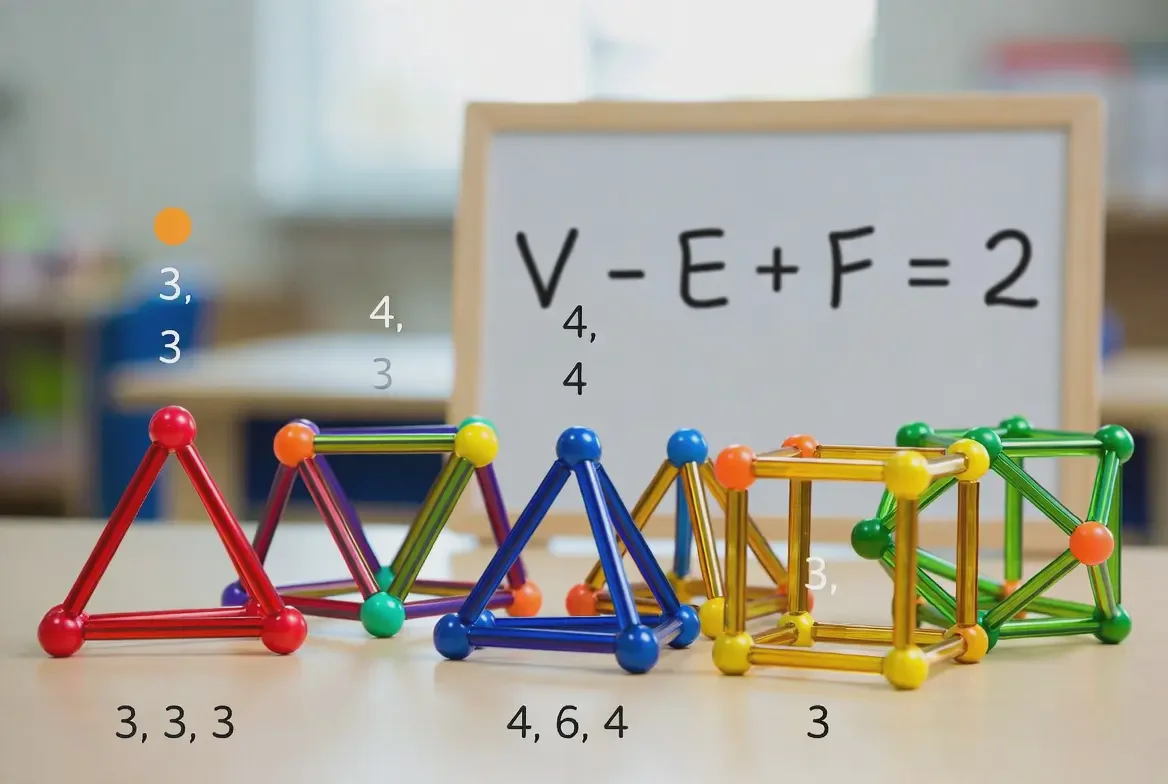
- Tetrahedron (4 triangular faces, 6 edges, 4 vertices)
- Cube (6 square faces, 12 edges, 8 vertices)
- Octahedron (8 triangular faces, 12 edges, 6 vertices)
- Dodecahedron (12 pentagonal faces, 30 edges, 20 vertices)
- Icosahedron (20 triangular faces, 30 edges, 12 vertices)
- Euler’s Formula Visualization: After building any convex polyhedron, students count faces (F), vertices (V), and edges (E) and discover V – E + F = 2. The physical model makes this abstract formula concrete and verifiable every time.
- Prisms & Pyramids: Build triangular or rectangular prisms, then compare them to pyramids — students see how base polygons determine the 3D shape.
- Nets to 3D Transition: Lay sticks flat as a net (2D pattern), then “fold” them up into the polyhedron to demonstrate the relationship between 2D and 3D.
Educational Outcome: Students gain deep intuition for 3D geometry, symmetry, and structural stability (triangles are rigid; squares can shear without diagonal braces).
Why Magnetic Sticks Are Superior for Geometry Education in 2026
- Instant Feedback: Magnets snap into place — wrong angles or missing sides simply won’t connect.
- Tactile & Collaborative: Multiple students can build together, encouraging discussion of properties.
- Scalable Difficulty: Start with simple triangles for kindergarten; progress to icosahedrons and Euler’s formula for grades 5–8.
- Reusable & Low-Mess: No glue or tape needed; everything disassembles cleanly.
- Cross-Curricular Links: Combine with art (symmetry patterns), engineering (strongest structures), and even physics (magnetic forces).
Research and classroom reports confirm magnetic building tools significantly improve spatial reasoning and geometry retention compared with worksheets alone.
Quick Starter Lesson Plan (45 Minutes)
- Warm-up (10 min): Build basic polygons and name their properties.
- Core Activity (20 min): Construct one Platonic solid and verify Euler’s formula.
- Challenge (10 min): Modify the shape (add a pyramid on a face) and discuss what changes.
- Reflection (5 min): “What did the model teach you that a drawing could not?”
FAQ
What age group is best for magnetic sticks in geometry?
Ages 4–12. Younger kids focus on polygons and basic 3D shapes; older students tackle Platonic solids and Euler’s formula.
Do I need special magnetic sticks or will any rod set work?
Premium sets like PicassoTiles or Neobuildr with strong magnets and precise lengths work best for accurate angles and stable polyhedra.
Can magnetic sticks demonstrate irregular polyhedra too?
Absolutely — they’re excellent for Archimedean solids, prisms, and custom student-designed shapes.
How do magnetic sticks help with Euler’s formula?
The physical counting of faces, vertices, and edges on a real model makes the formula V – E + F = 2 obvious and memorable.
Are these sets safe for classroom use?
Yes — ASTM F963-compliant sets use sealed magnets and large components that meet small-parts safety standards.
Magnetic sticks transform dry geometry lessons into exciting, memorable explorations. Whether building a simple triangle or a complex dodecahedron, students don’t just learn about polygons and polyhedra — they physically experience them. In 2026 classrooms and homes, these affordable STEM tools continue to prove that the best way to understand geometry is to build it.
Dofollow External Links :
Practical guide to building 3D polyhedra from flat nets using magnetic construction tools.Step-by-step at-home activity for constructing Platonic solids and verifying Euler’s formula (easily adapted to magnetic sticks).
Manufacturer overview highlighting how magnetic rods teach polygons, polyhedra, symmetry, and advanced geometry concepts.
Video demonstration of building polygons and polyhedra with magnetic tiles/rods (Magblox activity book examples).