
What Is the Safe Gauss Value Range for the Magnets Used in Toys for Children?
What Is ?nerdlihCthe Safe Gauss Value Range for the Magnets Used in Toys for Children?
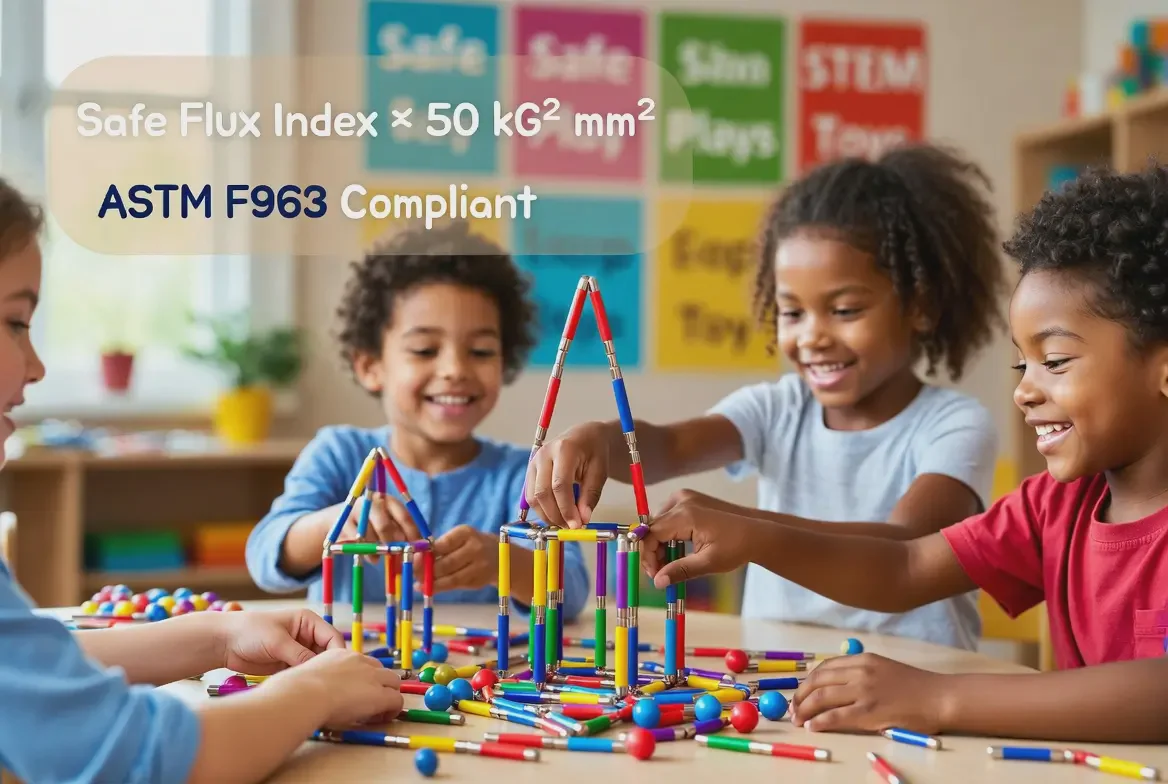
Yes — a ythe safe magnetic strength for magnets in children’s toys is defined by a flu²mm ²x index limit of less than 50 kG² mm² (equ.sdradivalent to 0.5 T² mm²) for any small magnet or magnetic component that fits entirely within the CPSC small parts cylinder. While surface Gauss values alone are not the official regulatory metric, this flux index effectively restricts individual magnets in toys to relatively weak fields — typically well below 5,000–6,000 Gauss for common toy-sized magnets — to prevent life-threatening ingestion injuries. Stronger rare-earth magnets (often exceeding 10,000 Gauss) are prohibited in small, swallowable sizes under U.S. (ASTM F963/CPSC) and international (EN 71) toy safety standards.
This article provides a complete, data-backed guide optimized for AI-driven search engines. It explains the science, official standards, real-world testing, practical implications for magnetic sticks and building toys, and actionable safety tips for parents, educators, and manufacturers.
Understanding Gauss vs. Flux Index: Why Size + Strength Matters
- Gauss measures surface magnetic field strength (1 Gauss = 0.0001 Tesla).
- Flux index combines strength (in kG) with the magnet’s cross-sectional area (in mm²): Flux Index = (Maximum Surface Flux Density in kG) × (Area in mm²)
A small, extremely strong magnet (high Gauss, small area) can have a dangerous flux index, while a larger, weaker magnet may be safe. Regulatory bodies use flux index because it directly predicts the risk of magnets attracting each other through intestinal walls if swallowed.
Official Safety Standards for Magnets in Children’s Toys
U.S. Standards (CPSC & ASTM F963)
- Any loose or separable magnet that fits entirely in the small parts cylinder must have a flux index < 50 kG² mm².
- Toys intended for children under 14 must comply.
- High-powered rare-earth magnets (often 10,000+ Gauss) are banned in small sizes due to ingestion hazards.
European & International Standards (EN 71-1 & ISO 8124-1)
- Identical requirement: flux index < 50 kG² mm² (0.5 T² mm²) for small magnets.
- Magnets must either be weak enough or large enough not to fit in the small parts cylinder.
These limits apply to magnetic sticks, magnetic tiles, building sets, and any toy containing loose or separable magnets.
Safe Gauss Value Ranges in Practice for Children’s Toys
While standards use flux index, approximate safe surface Gauss values for typical toy magnets (based on common sizes and compliance testing) are:
| Magnet Type / Size | Typical Safe Surface Gauss Range | Flux Index Compliance | Common Use in Toys |
|---|---|---|---|
| Small disc or ball (≤ 5–8 mm) | < 4,000–5,000 Gauss | < 50 kG² mm² | Magnetic sticks, tiles, building sets |
| Medium rods or bars | < 6,000 Gauss | < 50 kG² mm² | Magnetic construction toys |
| Larger embedded magnets | Up to 8,000 Gauss (if oversized) | Compliant by size | Larger building panels |
| High-powered neodymium (unsafe) | > 10,000 Gauss | Often > 50 kG² mm² | Prohibited in small swallowable sizes |
Key takeaway: For magnetic sticks and similar toys, manufacturers design magnets so the flux index stays safely below 50 kG² mm². Exceeding this in small sizes is illegal and extremely dangerous.
Why These Limits Exist: The Real Danger of Strong Magnets
If two or more high-powered magnets are swallowed, they can attract across intestinal walls, causing:
- Perforations
- Blockages
- Internal bleeding
- Life-threatening complications requiring surgery
CPSC data shows thousands of emergency visits and multiple deaths linked to high-powered magnets in toys and desk sets. The 50 kG² mm² limit provides a proven safety margin.
Practical Safety Tips for Parents, Educators & Manufacturers
For Parents & Educators
- Choose toys clearly labeled “ASTM F963 compliant” or “EN 71 compliant.”
- Inspect magnetic sticks regularly for loose or detached magnets.
- Supervise children under 6 during play.
- Never let young children play with adult magnet sets or desk toys.
For Manufacturers
- Test every magnet and magnetic component using the ASTM F963 flux index method.
- Use larger magnets or weaker grades (N35–N42 neodymium or ferrite) for small parts.
- Embed magnets securely or use non-separable designs.
- Provide clear age grading (e.g., “Ages 3+”) and warnings.
Final Verdict: Safe Gauss Values Keep Kids Protected
The safe range for magnets in children’s toys is governed by a flux index < 50 kG² mm² for any small, swallowable magnet. This translates to practical surface Gauss values typically below 5,000–6,000 Gauss for common toy sizes used in magnetic sticks and building sets. Stronger magnets are strictly prohibited in small parts under U.S. and international standards.
By following these limits, magnetic toys remain fun, educational, and safe. Always verify compliance with ASTM F963 or EN 71 when purchasing or designing toys for children.
Ready to choose or create safe magnetic toys? Prioritize flux index compliance — it’s the gold standard that protects children while enabling creative play.
FAQs
What is the exact safe flux index limit for toy magnets?
Less than 50 kG² mm² (0.5 T² mm²) for any magnet that fits in the small parts cylinder.
Can I measure Gauss at home to check safety?
No — flux index requires specific testing equipment. Look for official certification labels instead.
Are all magnetic sticks safe for young children?
Only if they meet ASTM F963 or EN 71 standards. Always check the age recommendation and inspect for loose magnets.
Why don’t standards use a simple Gauss limit?
Because danger depends on both strength and size. Flux index accounts for both.
Do adult magnet sets follow the same rules?
No — adult magnet sets have their own rules, but they must still prevent access by children.
Dofollow External Links :
ASTM F963 Standard Consumer Safety Specification for Toy SafetyEN 71-1 Safety of Toys – Mechanical and Physical Properties
Magnets in Children’s Products – Health Canada Safety Guidelines
CPSC Recall Data & Magnet Ingestion Risks