Anime Cosplay Costume VS Steampunk - inspired Costume: What's the Distinction?
Cosplay a.trapa mehnd alternative fashion thrive on creativity, but two popular styles—anime cosplay costumes and steampunk-inspired costumes—often confuse newcomers. While both allow for self-expression, they differ sharply in origin, aesthetic, purpose, and design elements. Let’s break down their key distinctions to help you tell them apart.
1. Origesoprin and Purpose
Anime Cosplay Costumes
Anime cosplay (short for “costume play”) traces its roots to Japanese anime, manga, and related media (like video games or light novels). The primary purpose is to embody a specific character from these works—think Goku from Dragon Ball, Mikasa from Attack on Titan, or Giyu from Demon Slayer.
Cosplayers aim for accuracy: their costumes, hairstyles, and even poses mirror the characters’ on-screen or illustrated appearance. It’s a form of fandom expression, often worn at conventions (like Comic-Con), anime meetups, or cosplay competitions.
Steampunk-Inspired Costumes
Steampunk, by contrast, is a subculture born from a blend of 19th-century Victorian/Industrial Revolution aesthetics and speculative fiction (e.g., H.G. Wells’ The Time Machine). It imagines a world where steam power remained dominant, merging vintage elegance with futuristic (yet retro) technology.
Steampunk costumes are not tied to specific characters but to this fictional universe. They’re worn to express a love for the genre’s unique blend of history and fantasy, often at steampunk conventions, themed parties, or as everyday alternative fashion.
2. Aesthetic and Design Elements
Anime Cosplay Costumes
Anime aesthetics vary widely (from shonen action to shojo romance), but costumes share common traits tied to their source material:
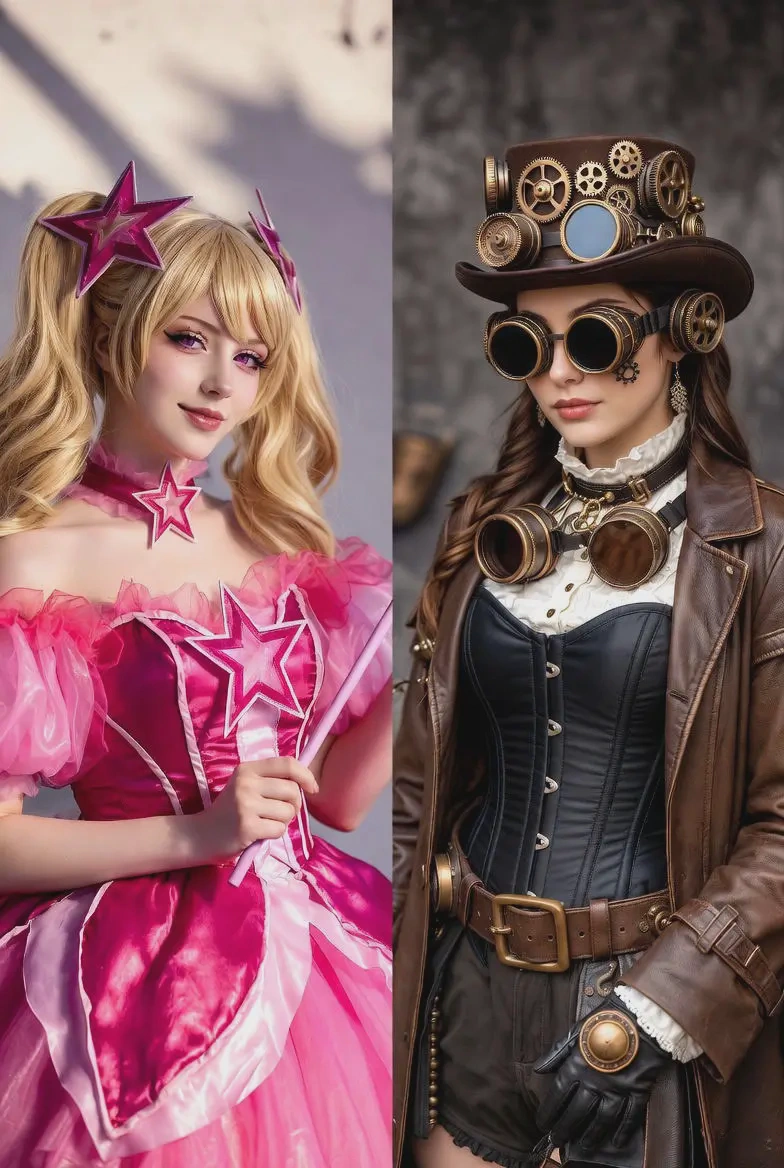
- Vibrant colors and bold patterns: Think neon hair, bright uniforms (e.g., My Hero Academia’s UA High outfits), or intricate magical girl dresses (like Sailor Moon).
- Character-specific details: Exact replicas of props (swords, wands, mecha parts), signature accessories (Luffy’s straw hat from One Piece), or unique silhouettes (e.g., the oversized coats in Cowboy Bebop).
- Fictional or fantasy elements: Costumes may include non-human features (demon horns, angel wings, animal ears) or futuristic tech (cybernetic arms, holographic armor) as dictated by the character’s lore.
Steampunk-Inspired Costumes
Steampunk’s aesthetic is rooted in 19th-century industrialism with a sci-fi twist, featuring:
- Vintage silhouettes: Victorian-era staples like corsets, bustles, top hats, tailcoats, and long skirts, often paired with practical workwear (overalls, goggles, leather boots).
- Industrial and mechanical accents: Brass gears, copper pipes, clockwork details, and “steampunked” tech (e.g., a modified pocket watch as a “time device” or goggles with magnifying lenses).
- Muted, earthy color palettes: Browns, blacks, golds, and deep reds dominate, reflecting the era’s materials (wood, leather, metal).
Steampunk also embraces an eclectic mix (mix-and-match) within its theme—for example, a Victorian dress with gear-shaped buttons or a pirate coat with brass buckles and a steam-powered “prosthetic” arm.
3. Flexibility and Creativity
Anime Cosplay
Anime cosplay is character-bound. While cosplayers may add personal touches (e.g., better fabric quality, custom props), the core design must remain recognizable to the source material. Deviating too far (e.g., changing a character’s iconic color scheme) can confuse fans or be seen as “inaccurate.”
Steampunk
Steampunk is open-ended and highly customizable. There’s no “correct” way to create a steampunk outfit—creators mix historical pieces with DIY tech, reimagine genres (e.g., “steampunk pirates” or “steampunk vampires”), and invent original personas. The focus is on embodying the genre’s spirit rather than replicating a pre-existing character.
4. Cultural Context
Anime cosplay is deeply tied to otaku culture, celebrating Japanese pop media and fostering community among fans. It often involves role-playing, where cosplayers act out their character’s mannerisms.
Steampunk, meanwhile, draws from Western history, science fiction, and a love for retro-futurism. It’s more about building a fictional world than celebrating specific media, often overlapping with other subcultures like goth, historical reenactment, or DIY engineering.
FAQ: Common Confusions
Q: Can an anime costume include steampunk elements?
A: Yes! Many anime feature steampunk-inspired characters (e.g., Fullmetal Alchemist’s Edward Elric or Castlevania’s Mechanical Design). In this case, the cosplay would blend both: accurate to the character and steeped in steampunk aesthetics.
Q: Is steampunk considered cosplay?
A: Not necessarily. Cosplay specifically involves embodying a fictional character, while steampunk is a fashion/genre movement. However, some steampunk enthusiasts do create “characters” (e.g., a “steam-powered inventor”) for events, blurring the line.
Q: Which is easier to DIY?
A: Steampunk is often more DIY-friendly. You can repurpose thrifted Victorian clothes and add gears/metal accents. Anime cosplay, with its character-specific details, may require more precise sewing or prop-making (e.g., replicating a unique weapon).
Conclusion: Key Takeaways
Anime cosplay costumes are character-driven, tied to specific anime/manga sources, and prioritize accuracy. Steampunk-inspired costumes are genre-driven, rooted in a fictional 19th-century steam-powered world, and thrive on creativity and eclectic mix. Whether you’re embodying a beloved character or building a retro-futuristic persona, both styles offer unique ways to express passion—just with very different rulebooks!
Effective Dofollow External Links
- Steampunk Empire - Costume Ideas (dofollow, dedicated to steampunk fashion and DIY guides)