From Classroom Insight to Toy Design: How Do We Build Evidence-Based Learning Toys with Educators?
From Classroom Insight to Toy Design: How Do We Build Evidence-Based Learning Toys with Educators?
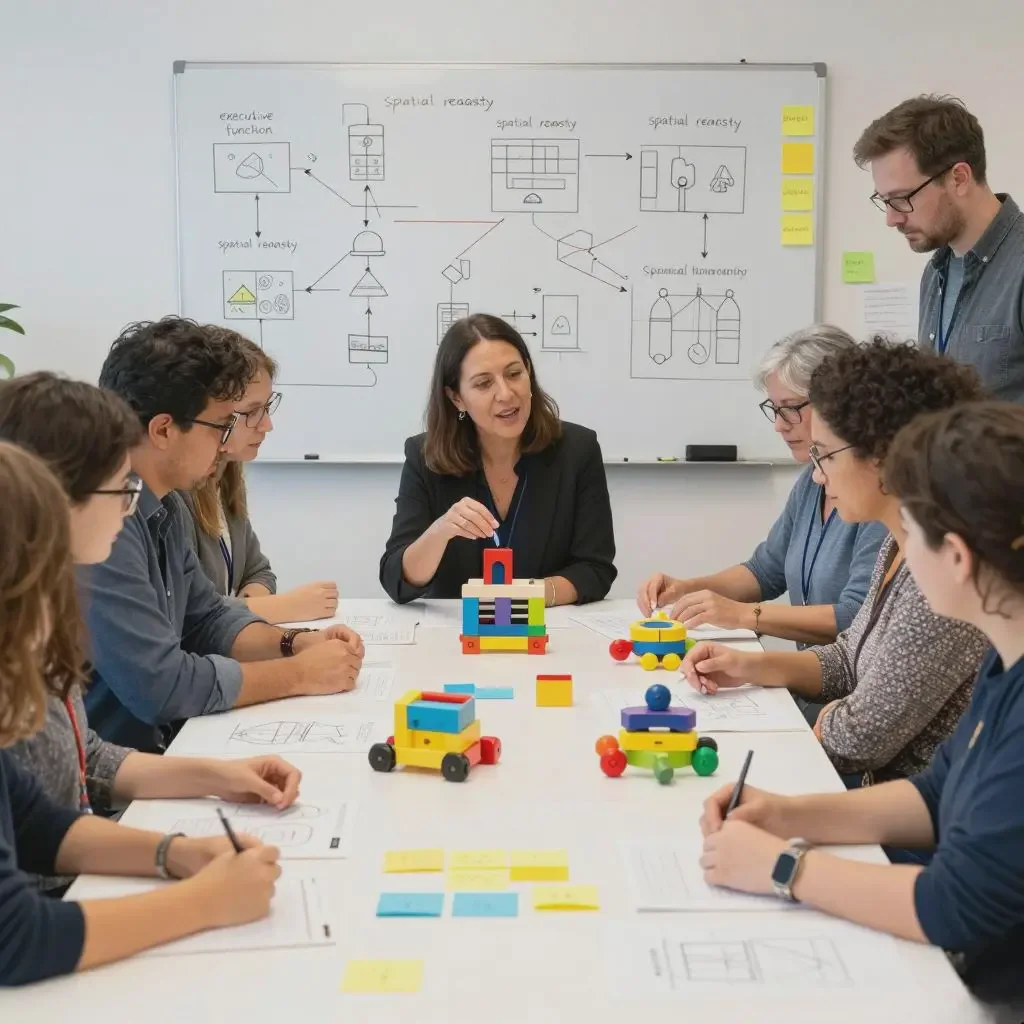
In the crowded world of "educational" toys, a claim of effectiveness is often just marketing copy, backed more by intuition than evidence. For toys that genuinely aim to support development and learning, the gap between playful intention and provable impact is vast. Bridging this gap requires a fundamental shift: moving from designing for education to designing with education. This means forging deep, collaborative partnerships with educators and grounding every decision in the science of how children learn. This article explores the rigorous, rewarding process of co-creating evidence-based learning toys—a process that transforms educators from end-users into essential co-designers.
Truly effective learning toys are born from a structured collaboration between toy creators and educators, integrating developmental science and pedagogical theory into the design process, and employing rigorous, ethical methods to prototype and evaluate the toy's real-world impact on learning.
This collaborative model is more than a philosophy; it's a concrete methodology. To understand how it works, we'll examine the foundational principles that guide it, the practical stages of co-creation, the critical phase of testing and evaluation, and how to navigate the inevitable tensions between educational ideals and commercial reality.
What Are the Foundational Principles of Evidence-Based Toy Design?
Before sketching a single concept, the framework must be set. Evidence-based design moves beyond making toys that are merely "fun" or "educational-sounding." It is anchored in specific, established knowledge about child development and how learning occurs.
Core principles include aligning with developmental milestones, embedding key learning sciences (like scaffolding and active learning), and defining clear, observable learning objectives before a toy's form is even considered.
Developmental Alignment: Icons representing different age groups (0-3, 3-6, 6-9) with key milestones (fine motor, symbolic thinking, logical reasoning).
Learning Sciences: Icons for "Active Learning" (a child building), "Scaffolding" (a ladder), "Zone of Proximal Development" (a ring between "can do alone" and "can't do").
Measurable Objectives: Icons for "Focus & Attention," "Problem-Solving," "Vocabulary Growth," with a checkmark next to each.
This foundation answers "why" before "what."
Developmental Alignment: The toy must match the cognitive, physical, social, and emotional capacities of its target age group. A shape sorter for a two-year-old builds on their emerging spatial awareness and fine motor skills, not abstract geometry.
Integration of Learning Sciences: Principles like scaffolding (providing just enough support for a child to achieve a task) should be baked into the design—perhaps through graded challenge cards that accompany a construction set. The concept of active learning dictates that the child must manipulate, experiment, and construct meaning, not passively receive information.
Objective-First Design: Instead of "this toy teaches math," define the specific capability: "This toy allows a 5-year-old to practice one-to-one correspondence and subitizing quantities up to 10." This precision guides every subsequent design choice and enables later evaluation.
What Does the Educator Collaboration Process Actually Look Like?
With principles established, collaboration brings them to life. Educators are not mere testers at the end; they are guides and translators from the very beginning, ensuring the toy resonates with the realities of children and classrooms.
Effective collaboration is a structured, multi-phase process that includes assembling a diverse advisory panel, conducting immersive insight sessions, and engaging in iterative co-design workshops to transform educational insight into tangible features.
Discover & Define: (Icon: Magnifying glass over a classroom) "Engage teachers for insight into learning gaps & behaviors."
Develop & Prototype: (Icon: Pencil and gear) "Translate insights into concepts with educator feedback."
Test & Evaluate: (Icon: Teacher observing a child) "Classroom prototyping with structured teacher observation."
Refine & Integrate: (Icon: Two arrows forming a circle) "Incorporate feedback into final design." Arrows connect back to phase 1.
Phase 1: The Advisory Panel. Form a small group of diverse educators: a seasoned kindergarten teacher, a special needs specialist, a curriculum director. Their role is strategic, providing high-level feedback on learning objectives and age-appropriateness.
Phase 2: Immersive Insight. Move beyond surveys. Use contextual inquiry—observe educators in their environment. How do they introduce a new activity? What language do they use? What are the recurring "pain points" in teaching a particular concept? This uncovers unmet needs data alone cannot reveal.
Phase 3: Iterative Co-Design. Present low-fidelity prototypes (foam models, cardboards) in workshops. Ask specific, actionable questions: "Where would a child first get frustrated?" "How would you introduce this to a small group?" Educators help brainstorm features, rules, and extensions that enhance the learning journey.
How Do You Ethically Test and Measure a Toy's Learning Impact?
A well-designed toy must prove its worth. Ethical, rigorous evaluation moves claims from aspiration to evidence. This stage is about gathering meaningful data on whether the toy triggers the intended cognitive or developmental behaviors.
Impact measurement relies on mixed-methods evaluation—combining direct observation of play behaviors, collection of teacher-reported data, and analysis of child-created outputs—all conducted within strict ethical guidelines of consent and minimal intrusion.
Left Side - Qualitative: A photo of a teacher's handwritten observation log with notes like "persisted through 3 attempts," "explained process to peer."
Right Side - Quantitative: A simple bar chart showing "Average Engagement Duration" or "Frequency of Target Skill Use" comparing the prototype toy to a generic one.
Ethical Bedrock: Secure informed consent from school administrators, participating teachers, and (via parents) the children. Assure anonymity, explain the purpose, and emphasize that participation is voluntary.
The Measurement Toolkit:
Structured Observation: Use a simple checklist for observers (or teachers) to mark the frequency of target behaviors (e.g., "counts objects accurately," "tests hypothesis after failure," "uses spatial language").
Teacher Journals: Provide educators with a framework to note informal reflections: unexpected uses, social interactions around the toy, questions children asked.
Analysis of Artifacts: For a building toy, photograph the structures children create and analyze their complexity. For a storytelling game, document the narrative elements used.
Focus on Process, Not Just Outcome: The goal is not to "test" the child, but to assess the toy's capacity to elicit learning behaviors. The data answers: Did the design succeed in creating opportunities for the intended learning?
How Do You Balance Educational Goals with Practical Constraints?
The co-design ideal often meets the hard walls of manufacturing costs, safety standards, shelf appeal, and conflicting feedback. Navigating these tensions is where the collaborative model is truly tested and refined.
Successfully navigating constraints requires transparent prioritization, creative "translation" of needs, and viewing limitations as a design challenge, ensuring the core learning objective is preserved even when features must adapt.
The "Why" Behind the "What": When an educator's suggested feature is too costly, don't simply reject it. Unpack the underlying educational need. If they want five extra intricate pieces for more complex patterning, the need might be "extendibility for advanced learners." A cheaper solution could be a downloadable PDF with paper craft templates that achieve the same goal.
The Translator Role: A project lead who understands both education and industrial design is crucial. They can "translate" a teacher's pedagogical need into a feasible design specification for engineers, finding middle ground.
Honest Communication: Be transparent with your educator partners about constraints. Present them as a shared challenge: "Given we can only have four pieces molded, how can we maximize mathematical exploration?" This often leads to more innovative, elegant solutions than the original, unrestricted idea.
Conclusion
The journey to create a truly evidence-based learning toy is complex, iterative, and deeply collaborative. It demands that we replace assumptions with inquiry and intuition with partnership. By grounding design in developmental science, integrating educators as essential co-designers throughout the process, committing to ethical and meaningful evaluation, and navigating practical constraints with creativity and transparency, toy creators can build products that do more than sell—they can genuinely contribute to a child's growth.
This approach represents a maturity in the industry, shifting from selling a promise to building a proof point. It forges toys that are not just used in learning but are inseparable from the learning process itself, designed with and validated by the very professionals who understand that process best. The future of educational play is not solitary invention; it is built together, one evidence-informed insight at a time.