Developmental Infant Toy Manufacturing: Science-Backed Production Guide 2024
Developmental Psychology-Based Infant Toy Manufacturing: 2024 Professional Production Guide
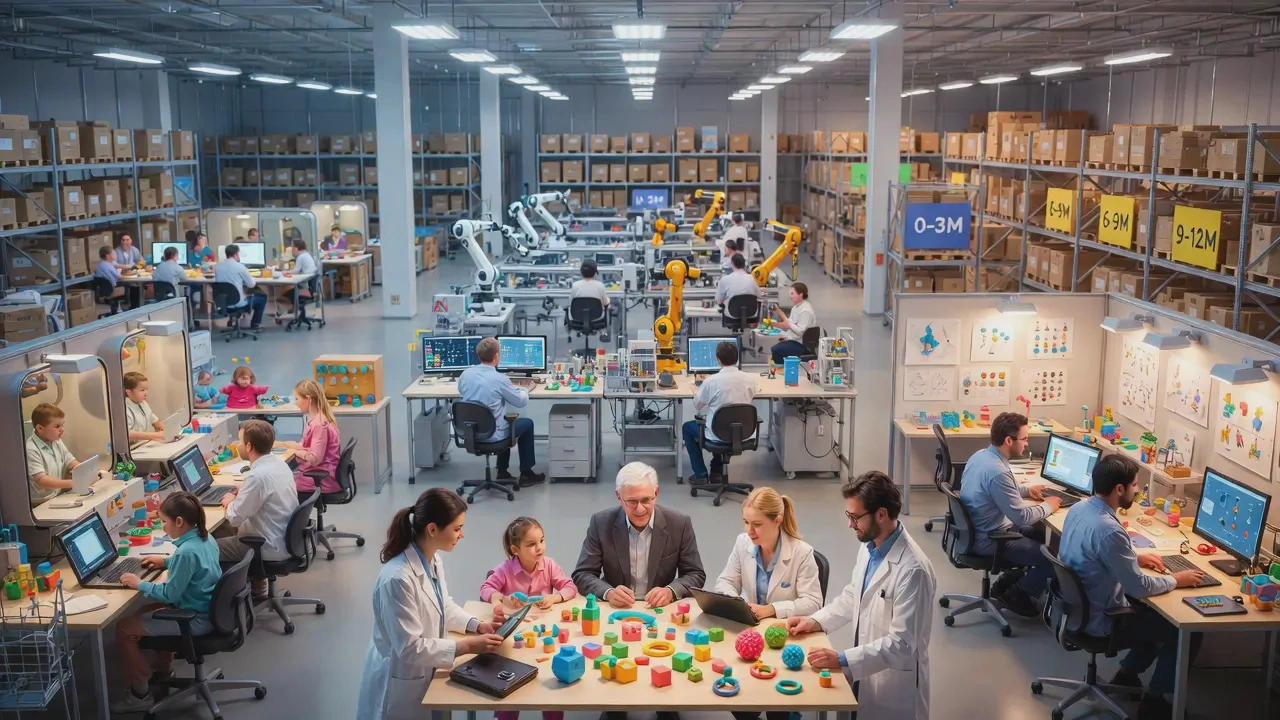
For fo g infant toy manufacturers seeking to establish professional credibility in the global market, a deep understanding of developmental milestones from newborn to early toddler stages is essential. Manufacturing toys that align with infant development stages goes beyond meeting safety standards—it involves creating products that genuinely support early cognitive, sensory, and motor skill growth. This article provides a detailed analysis of the complete manufacturing considerations, from newborn toys production to educational toys for early toddlers.
Understanding Developmental Needs and Corresponding Manufacturing for Each Age Stage
0–3 Months: Sensory Foundation Building Stage
Newborns’ vision is not fully developed, and they are most sensitive to high-contrast patterns. Therefore, the manufacturing process for high-contrast toys requires special attention to color design. Research shows that combinations of black, white, and red are most effective in attracting newborns’ attention.
Key Manufacturing Points:
Material Selection: Must use food-grade silicone, organic cotton, or other mouth-safe materials
Pattern Printing: Employ environmentally friendly, non-toxic inks to ensure vibrant colors that do not peel
Sound Design: Incorporate crinkle paper or gentle bells with volumes below 60 decibels
Size Control: Toy diameter must exceed 4.5 cm to prevent choking hazards
On the newborn toys production line, we establish a dedicated “Sensory Testing Station” that simulates an infant’s visual distance (20–30 cm) for quality inspection, ensuring each toy offers optimal visual effects at the appropriate distance.
3–6 Months: Exploration and Grasping Skill Development Stage
At this stage, infants begin to consciously grasp objects and explore orally. Production standards for safe teething toys factories must meet medical-grade requirements.
Critical Manufacturing Techniques:
One-Piece Molding Process: Eliminates any small parts that could detach
Texture Diversity: Design at least three different textures on a single teether to stimulate oral perception
Temperature-Sensitive Materials: Incorporate thermochromic materials in premium products that change color upon contact with saliva to indicate cleaning needs
Floating Center of Gravity Design: Ensures toys are easily graspable in any position
6–9 Months: Rapid Motor Skill Development Stage
As infants learn to sit and crawl, crawling baby toys OEM products should encourage movement development.
Manufacturing Innovations:
Interactive Tracking Systems: Design visual guiding paths on activity mats
Multi-Position Fixation Devices: Allow the same toy to be safely secured to cribs, car seats, or floors
Progressive Difficulty Design: Gradually increase the complexity of interactive elements as the infant’s abilities improve
Waterproof Treatment Technology: Ensure toys can be used in various environments, including bathrooms
9–12 Months: Cognitive Skill Breakthrough Stage
Infants begin to understand cause-and-effect relationships and simple problem-solving. 9–12 month learning toys suppliers must provide products with greater cognitive challenges.
Manufacturing Technical Requirements:
Modular Design: Allows parents to adjust the difficulty level of the toy
Bilingual Labeling Systems: Meet the needs of globalized markets
Error Control Functionality: Provides gentle corrective feedback when the infant makes an operational error
Expansion Connection Points: Compatible with toy systems for subsequent age stages
Toy Design and Manufacturing Principles Based on Developmental Psychology
Materials Science and Developmental Safety
In premium infant toys OEM production, material selection directly impacts product safety and developmental appropriateness:
Sensory Development Material Matrix:
Tactile: Include at least four basic textures: smooth, rough, soft, and hard
Auditory: Different materials produce sounds at varying frequencies when colliding
Visual: Follow color development patterns, transitioning from high contrast to softer tones
Progressive Safety System:
0–6 Months: All materials must meet food-contact grade standards
6–12 Months: Additional requirements for wear resistance and impact resistance
12+ Months: Introduction of more complex material combinations
Manufacturing Processes and Quality Control
Methods for manufacturing Montessori infant toys emphasize natural materials and authentic experiences:
Wood Treatment Technology:
Use FSC-certified hardwoods
36-step sanding process ensures perfectly smooth surfaces
Natural oil coatings avoid chemical paints
Wood grain direction matches grip force lines in design
Sensory Toy Production Processes:
Fillings for each sensory bag undergo strict screening and proportioning
Sealing processes meet medical-grade waterproof and leak-proof standards
Multi-layer safety barrier designs prevent any possibility of leakage
2024 Infant Toy Manufacturing Trends and Technology Integration
Intelligent and Traditional Integration
Modern baby toy trends manufacturing is no longer just about digitization but the optimal fusion of intelligence and tradition:
Screen-Free Interactive Technologies:
RFID-guided physical toy interactions
Pressure-sensitive floors combined with physical toys
Sound localization feedback systems
Sustainable Manufacturing Processes:
Increase the use of bio-based plastics to over 40%
Zero-waste production flow designs
Fully recyclable packaging solutions
Personalized Manufacturing Capabilities
As a professional educational toys manufacturer, we offer the following customization services:
Developmental Assessment Integration: Adjust toy parameters based on the developmental standards of target markets
Cultural Adaptability Modifications: Localize toy patterns, colors, and themes
Special Needs Design: Provide specially optimized products for premature infants or those with developmental delays
Comprehensive Manufacturer Solutions: From Concept to Market
Phase 1: Research and Design (1–2 Weeks)
Consultation with developmental psychology experts
Analysis of target age-stage capabilities
Pre-review of safety standards
Phase 2: Prototype Development (2–3 Weeks)
Rapid prototyping with 3D printing
Small focus group testing
Pre-testing in safety laboratories
Phase 3: Mass Production (4–6 Weeks)
Combination of fully automated production lines and manual fine-finishing
Random sampling of 30% from each batch for comprehensive testing
Final verification of developmental appropriateness
Phase 4: Certification and Delivery (1–2 Weeks)
Obtain all necessary certifications for target markets
Preparation of educational packaging and instructional materials
Optimized logistics and distribution
Guangxikangjamei’s Professional Manufacturing Advantages
At Guangxikangjamei Import & Export Co., Ltd, we integrate developmental psychology toy design principles into every manufacturing step:
Professional Team Composition
Child developmental psychologists participate in product design reviews
Materials scientists optimize safety and sensory characteristics
Experienced artisan teams ensure precision craftsmanship
Advanced Manufacturing Facilities
100,000-class cleanroom production workshops
Fully automated sensory testing equipment
Real-time quality monitoring systems
Environmental processing and recycling systems
Compliance and Certifications
ISO 9001:2015 Quality Management System
Full capability for EU EN71 certification
Compliance with US ASTM F963 standards
Implementation of Australian AS/NZS ISO 8124 standards
Implementation Roadmap: Starting Your Professional Infant Toy Manufacturing Project
Step 1: Needs Analysis and Positioning (1 Week)
Define target age stages, market regions, price positioning, and developmental focus areas
Step 2: Concept Design and Prototyping (2–3 Weeks)
Our design team will provide three initial proposals for selection
Step 3: Safety Testing and Modifications (1–2 Weeks)
Complete all necessary testing in our internal laboratories
Step 4: Small-Batch Trial Production (1 Week)
Produce 100–500 samples for market testing
Step 5: Full-Scale Production (4–8 Weeks)
Arrange optimal production schedules based on order volume
Step 6: Ongoing Support and Improvement
Provide sales data analysis and product iteration recommendations
Case Study: Multi-Age Stage Toy Series Development Practice
We recently completed a project involving the full-series development of 0–12 month toys factory products:
Project Challenge:
The client required a toy series covering the entire infant period, demonstrating developmental continuity
Solution:
Unified Design Language: All toys use the same color system and material textures
Progressive Skill Development: Each toy targets specific developmental milestones
Family Sharing Functionality: Toys for different age stages can interact with each other
Expansion Possibilities: Reserve interfaces for subsequent product development
Manufacturing Outcomes:
Development Cycle: 12 weeks
Product Quantity: 8 core toys + 12 expansion accessories
Market Response: Entered specialized parenting stores in three countries within six months
Safety Record: Zero product recalls
Future Outlook: Directions in Infant Toy Manufacturing
Technology Integration Trends
Seamless integration of physical toys and digital experiences
Development of biofeedback toys
Tracking personalized developmental pathways
Sustainable Development
Application of fully biodegradable materials
Carbon-neutral production processes
Circular economy models for toy rental systems
Inclusive Design
Design for infants of all ability levels
Enhanced cross-cultural adaptability
Optimized price accessibility
Professional manufacturing begins with deep understanding. Every infant’s developmental journey is unique, and high-quality toys should accompany and support this process. At Guangxikangjamei, we believe the best toys are those based on science, meticulously manufactured, safe, and reliable.
Contact our professional team today to begin planning your next developmental infant toy. Let us create products that are not only safe and fun but truly support infant growth.